
Allibre vs. Cytopoint: Comparing Two Approaches to Canine Allergy Relief
Both are treatment options veterinarians may consider for canine atopic dermatitis, and they work in different ways. Here’s an honest look at how they compare, so you can have an informed conversation with your vet.
Considering Befrena? It’s a newer injection that works the same way as Cytopoint, so this comparison applies to it too. The differences are noted below.
| Attribute | Cytopoint / Befrena | Allibre |
|---|---|---|
| Delivery Method | Subcutaneous injection | Transdermal cream, applied to the ear pinna |
| Mechanism | Monoclonal antibody that blocks IL-31, an itch-signaling molecule (both work the same way) | Custom-formulated immunotherapy that gradually desensitizes the immune response to specific allergens |
| Dosing Frequency | One injection every 4–8 weeks (Cytopoint) or 6–8 weeks (Befrena) | Once daily |
| Administration | In-clinic, by a veterinarian or trained staff | At home, by the pet owner |
| Refrigeration | Required (Cytopoint) | Not required |
| Species | Dogs | Dogs and cats |
| Primarily Addresses | Itch symptom relief | Underlying allergic sensitization |
Comparison based on publicly available product information. Individual results vary by pet. This page is for general education and does not replace a diagnosis or treatment plan from a licensed veterinarian.
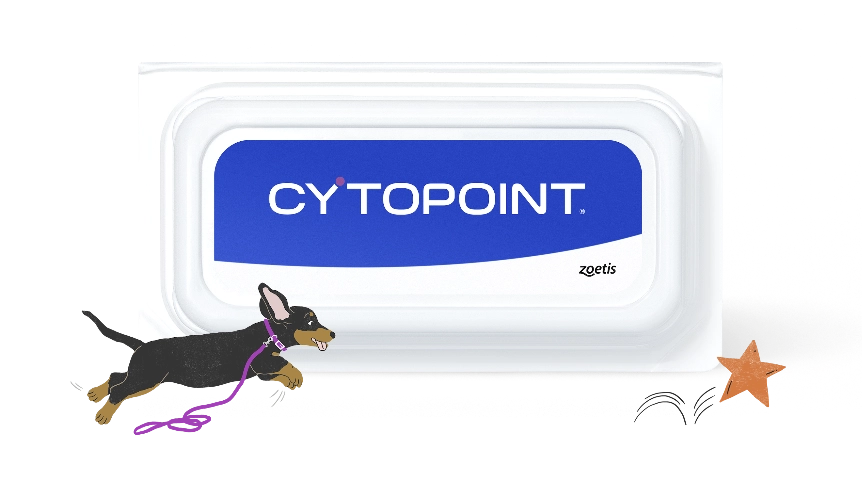
Cytopoint (lokivetmab) is an injectable monoclonal antibody therapy veterinarians use to control itching associated with canine atopic dermatitis by blocking IL-31 signaling. It’s typically given as an in-clinic injection every four to eight weeks. Made by Zoetis. See the official Cytopoint site →

Allibre is a custom-formulated transdermal cream that delivers a pet’s specific allergens through the skin in gradually increasing concentrations, aiming to build long-term tolerance rather than only suppress the itch response. It’s applied once daily by the pet owner at home.
Befrena (tirnovetmab), made by Elanco, is the first direct competitor to Cytopoint: another antibody injection that blocks IL-31. It received USDA approval in December 2025 and began a phased US launch in May 2026, so not every clinic stocks it yet. Elanco recommends it every six to eight weeks, compared with four to eight for Cytopoint. Otherwise, everything on this page about Cytopoint applies to Befrena: it’s an in-clinic injection for dogs that controls itch, not the allergy behind it. For the details, see Befrena vs. Cytopoint.
Anti-itch injections and Allibre work through different mechanisms, and some veterinarians use them together: Cytopoint or Befrena for fast symptom relief while Allibre’s immunotherapy works toward longer-term tolerance. Only a veterinarian who has examined your pet can recommend the right approach, or combination of approaches, for your pet’s specific allergies.
Common Questions
Is Allibre an alternative to Cytopoint?
They do different jobs. Cytopoint (lokivetmab) is an injection that blocks IL-31, a key itch signal, for roughly four to eight weeks at a time. Allibre is allergen immunotherapy: a daily cream that gradually retrains the immune response to the specific allergens a pet reacts to. Cytopoint treats the itch; immunotherapy targets the allergy behind it.
Can my dog have Cytopoint injections while using Allibre?
Yes, if your veterinarian recommends it. Many vets use an itch-control treatment such as Cytopoint to keep a dog comfortable while immunotherapy builds up over the first months, then reassess how often injections are needed.
Is Cytopoint immunotherapy?
Not in the allergy-desensitization sense. Cytopoint is licensed in the US as a "Canine Atopic Dermatitis Immunotherapeutic" because it's a monoclonal antibody, but it doesn't contain allergens and doesn't change how the immune system reacts to them. Allergen immunotherapy (shots, drops, or a cream like Allibre) does.
Can cats get Cytopoint?
Cytopoint is labeled for dogs. Allibre is formulated for both dogs and cats.
What is Befrena?
Befrena (tirnovetmab, made by Elanco) is a newer anti-IL-31 antibody injection for dogs, approved by the USDA in December 2025. Elanco describes a dosing interval of six to eight weeks and began a limited US launch in May 2026. It works the same way as Cytopoint: it controls itch rather than desensitizing the immune system to allergens. See Befrena vs. Cytopoint for a full comparison.
Is Allibre an alternative to Befrena?
The same way it is to Cytopoint: they do different jobs. Befrena blocks the IL-31 itch signal for six to eight weeks at a time; Allibre is allergen immunotherapy that targets the allergic response itself. A dog can be on Befrena or Cytopoint while Allibre builds up, if the veterinarian recommends it.
Which costs more over time, injections or a daily cream?
It depends on the clinic, your pet's size and how often injections are needed, so ask your vet for numbers. When comparing, include the visits: Cytopoint is given in the clinic every four to eight weeks and Befrena every six to eight weeks, while Allibre is applied at home and refilled as a three-month supply through your vet.
Curious how Allibre compares to other options? All allergy treatment options compared → · See Allibre vs. Apoquel → · See Allibre vs. Sublingual Immunotherapy →